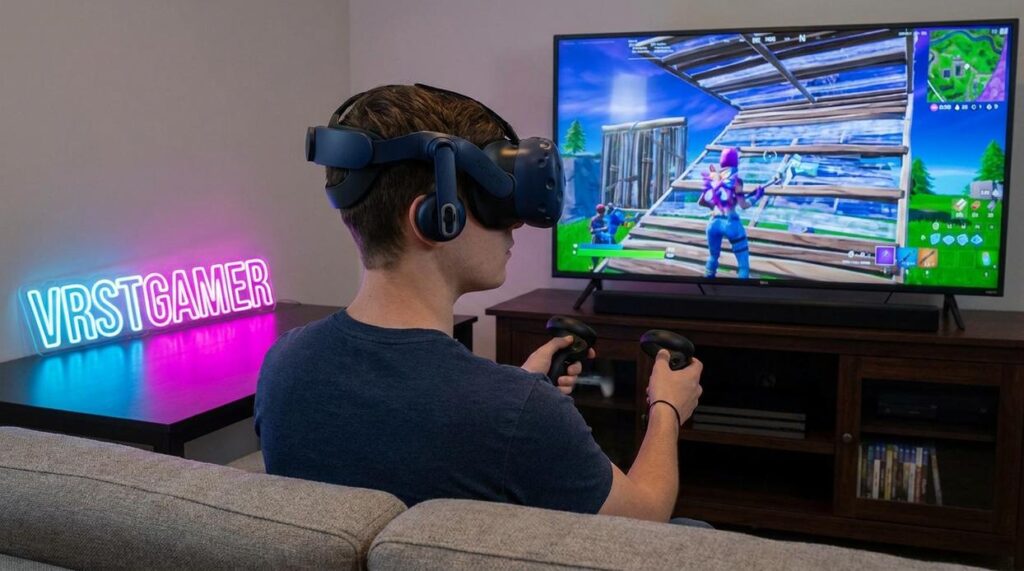
I remember the first time I dropped into Fortnite in VR.
Everything I knew about the game went out the window. The controls felt foreign. My aim was off. I kept turning my head when I should’ve been using the stick.
You’re probably dealing with the same thing right now. The transition from flat screen to VR isn’t just different. It’s disorienting.
Here’s the truth: how to play fortnite vrstgamer requires unlearning some habits and building new ones. The players who figure this out fast are the ones landing headshots while everyone else is still fumbling with reload mechanics.
I’ve spent hundreds of hours testing what actually works in VR Fortnite. Not theory. Real gameplay that separates players who struggle from players who dominate.
This guide walks you through everything. Getting comfortable with VR controls. Mastering the mechanics that only exist in this format. Using immersion as your advantage instead of your weakness.
We’re starting with the basics so you don’t get motion sick in your first match. Then we’re moving into combat techniques and building strategies that work specifically in VR.
No fluff about how cool VR is. Just the concrete steps that get you from awkward first drops to confident Victory Royales.
Step 1: Your VR Pre-Flight Checklist – Setup & Comfort
You can’t win if you’re dizzy.
I see new players jump into VR shooters all the time without touching their settings. Five minutes later they’re pulling off the headset feeling queasy.
Let me save you that headache.
Finding Your VR Legs
Motion sickness in VR is real. Your brain gets confused when your eyes say you’re moving but your body says you’re standing still.
The fix? Start with snap turning instead of smooth turning. Snap turning rotates your view in quick increments (usually 30 or 45 degrees). It feels choppy at first but your stomach will thank you.
Also turn on tunnel vision or vignettes. This darkens the edges of your screen during movement. It looks weird but it works.
Some players say these comfort settings are crutches that hurt your performance. That you should just power through and adapt to smooth movement right away.
But here’s what they’re missing. If you quit VR because you feel sick every session, you’ll never get good at all. Build your tolerance slowly. You can always disable these settings later when you’re ready.
Your Physical Space Matters
Clear your play area. I mean really clear it.
Room-scale VR lets you physically duck behind cover and peek around corners. Stationary play keeps you in one spot. Room-scale gives you a real edge in firefights because you can dodge incoming fire with your actual body.
Mark your boundaries. Know where your couch is without looking.
Dial In Your Visuals
Adjust your IPD (the distance between your pupils). Most headsets have a slider or software setting for this. Get it right and everything snaps into focus. Get it wrong and you’ll strain your eyes trying to aim.
Tighten the straps. A loose headset shifts around and blurs your vision right when you need that clean headshot.
Listen to Win
Put on good headphones. VR audio is 3D, which means you can hear exactly where enemies are.
Footsteps behind you? You’ll know. Someone building a ramp to your left? You’ll hear it before you see it. When you learn how to play fortnite vrstgamer style, audio becomes your second pair of eyes.
Once you’ve got these basics locked in, you’ll probably wonder about controller grip and button mapping. We’ll cover that next, but nail this foundation first.
Step 2: Mastering a New Muscle Memory – Movement & Controls
Most guides will tell you VR Fortnite is just regular Fortnite with a headset on.
That’s completely wrong.
I see players jump in thinking their console skills will carry over. They stand still while reloading. They try to strafe like they’re using a controller. They get eliminated in seconds and blame the game.
Here’s the truth. Your body is the controller now. Everything you learned about movement? You need to rethink it.
Your Body Is Your Best Defense
When bullets start flying, you don’t press a button to crouch. You actually crouch. Behind that wall. Behind that rock. Your physical body drops down and the game follows.
Same goes for peeking around corners. You lean your actual head out to scout for enemies. It feels weird at first (like you’re playing hide and seek in your living room) but it works.
People say this makes the game harder. I disagree. It makes it more honest. You can’t just spam the crouch button and expect to dodge shots. You have to move like you would if someone was really shooting at you.
The players who get this early? They’re the ones winning fights.
Grabbing loot works the same way. You reach out with your virtual hands and pick things up. No auto-collect. No holding a button. You physically grab that shield potion and bring it to your face to drink it.
Your inventory management matters more in how to play fortnite vrstgamer than you think. Set up your quick-access slots before you drop. Put your shotgun where your right hip would be. AR on your back. Heals on your left hip. Practice grabbing them without looking.
Now let’s talk about reloading.
This is where most players fall apart. You can’t just hit reload and wait. You eject the magazine. Reach down to your hip for a new one. Slide it in. Some weapons need you to rack the slide.
Do this wrong in a fight and you’re done. Practice in spawn island until your hands know what to do without thinking.
Moving across the map takes adjustment too. Smooth locomotion works but it can mess with your head if you’re new to VR. Combine forward movement with snap turns to check your surroundings. Don’t try to turn your whole body every time you need to look around.
Your muscles will remember. Just give them time.
Step 3: The VR Combat Advantage – Aiming & Building
Here’s something most guides won’t tell you.
The moment you stop thinking about aiming and just start doing it? That’s when VR clicks.
I’m serious. Your brain already knows how to point at things. You’ve been doing it since you were a kid. VR just lets you use that skill in Fortnite.
When you physically raise your controller to your eye and look down the sights, you’re not fighting against aim assist or wrestling with sensitivity settings. You’re just aiming. The same way you’d point at something across the room.
It’s faster than a mouse. More precise than a thumbstick.
And once you get the hang of it, going back feels weird.
But here’s where it gets better. Use your off-hand to support your weapon. I know it sounds basic, but most players skip this step. When you bring your second controller up to grip the virtual rifle or SMG, the game stabilizes your aim. Recoil drops. Your shots land where you’re actually looking.
Pro tip: This works best with ARs and SMGs. The difference is night and day once you stop one-handing everything.
Now let’s talk about building.
VR building isn’t about memorizing button combos. You select your piece with a quick gesture (wall, ramp, floor) and then you just point where you want it. The second someone shoots at you, you can throw up a wall without thinking about it.
That’s the whole point of how to play fortnite vrstgamer. Your hands do the work while your brain stays focused on the fight.
Editing is even simpler. You physically grab the tiles on your build piece and select what you want to change. Need a door? Grab the bottom tiles. Want a window? Select the middle. It feels natural because it is natural.
Some players say building in VR is harder to learn. They’re not wrong at first. But once it clicks, you’ll edit faster than you ever did with a keyboard. Your hands just know where everything is.
That’s your real advantage. Not better aim assist or stronger weapons. Just your own two hands doing what they already know how to do.
Step 4: Advanced Tactics & Drills for Improvement
You’ve got the basics down. You can build, you can aim, and you’re not dying every 30 seconds.
Now what?
This is where most VR Fortnite players hit a wall. They know how to play but they’re not getting better. They’re stuck in that middle zone where wins feel random instead of earned.
The difference between good and great in VR comes down to tactics you can only pull off with a headset on.
Let me show you what I mean.
The Build & Blindfire Technique
Here’s something you can’t do on a controller. You build a wall, then immediately peek and fire without moving your whole body into the open.
In VR, you just lean. Your character stays protected while you get the shot.
Compared to traditional Fortnite where you have to commit your entire hitbox? This is huge. Console players have to strafe out and expose themselves. You don’t.
Practice this: Drop into a Creative map and build a single wall. Now lean left, lean right. Get comfortable shooting from those angles without stepping out.
Mastering Verticality
VR changes everything about height advantage.
On a flat screen, tracking someone above you means awkward camera angles and guesswork. In VR, you just look up. Your spatial awareness is natural because the world actually surrounds you.
Taking high ground in VR feels different too. You can peek down over ramps and get clean shots that would be clunky with a mouse or stick.
But here’s the thing. Holding high ground versus pushing high ground requires different approaches in how to play fortnite vrstgamer.
When you’re pushing up, use your ability to look around corners while climbing. Snap your head to check angles before your body gets there.
When you’re defending from above, stay mobile. Don’t just stand at the edge. Move back, peek, shoot, move back again.
Recommended Practice Drills
Load into Creative and run these drills for 10 minutes before you jump into real matches.
First drill: Snap aiming. Place targets at different heights and distances. Practice snapping your aim to each one without moving your feet. This builds the muscle memory your arms need in VR.
Second drill: The 90s building technique. Yeah, it feels weird in VR at first (your arms will get tired). But once you nail it, you’ll understand how building speed translates to actual movement in three dimensions.
Reviewing Your Gameplay
Record your sessions. I know it sounds boring but trust me on this.
When you watch yourself play, you’ll catch things you never notice in the moment. Maybe you’re reloading at bad times. Maybe you expose your whole body when a lean would’ve worked better.
I review my own footage and still find habits I didn’t know I had. Last week I realized I was dropping my gun hand too low after building, adding a full second to my next shot.
Those little things add up to wins or losses.
Your New Playground Awaits
You came here wondering if Fortnite VR was worth the learning curve.
Now you have the roadmap.
The awkward first steps with VR controls don’t last forever. You get past them by practicing the fundamentals we covered here.
How to play fortnite vrstgamer isn’t about fighting the medium. It’s about using it to your advantage.
Physical aiming feels natural once you stop overthinking it. Movement becomes second nature when you trust your body. Building in VR turns into muscle memory faster than you’d expect.
This isn’t a gimmick. It’s a real edge over players stuck in traditional modes.
Here’s what you do next: Load up a Creative map right now. Pick one skill from this guide and focus on it. Try two-handed aiming for ten minutes.
You’ll feel the difference immediately.
The mechanics click when you give them a chance. Your gameplay improves when you stop treating VR like a novelty and start treating it like the tool it is.
The playground is ready. You just need to step in and play.